Why Erg Handle Height Changes Your Finish More Than Core Strength
Quick Answer: The handle should arrive at the bottom of your ribcage, roughly where a bra band sits, with your forearms level and your wrists flat. If it lands higher - at the collarbone or the middle of the chest - your elbows have to travel up and out, your shoulders shrug, and your torso leans back further to compensate. That backward lean is what people feel as a weak core. It is almost always a handle path problem, and it is fixable in one session.
Your core is probably fine. Your handle is going to the wrong address.
Where should the handle actually finish?
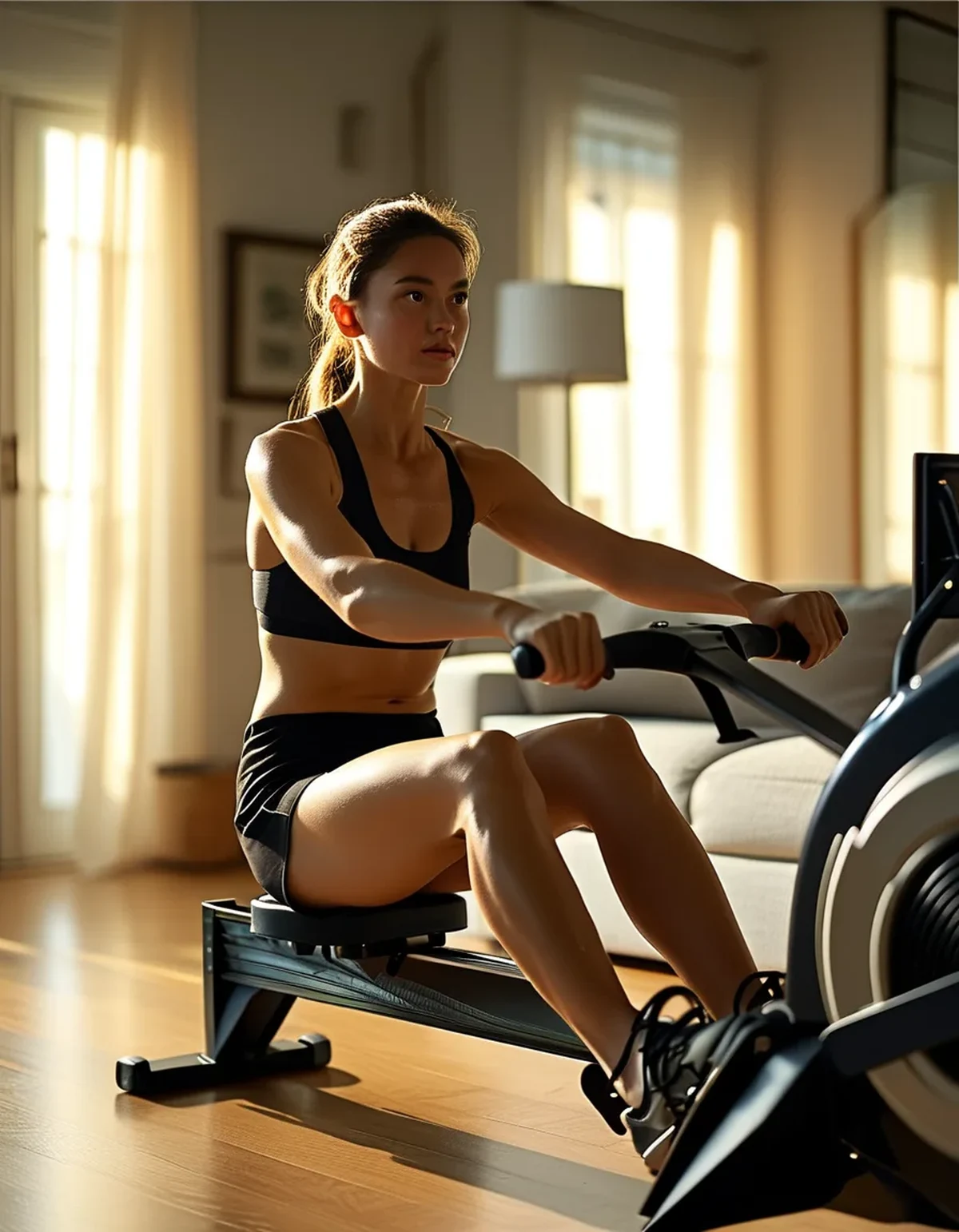
The target is the bottom of the ribcage, not the chest and not the waist. On most people that is somewhere between the bottom of the sternum and the top of the abdomen.
Your forearms should be roughly parallel to the floor at the moment the handle touches. If they angle upward, the handle came in high.
Wrists stay flat. A curled wrist at the finish is a reliable sign that the handle is arriving above its natural line and the hands are compensating.
Elbows draw past the ribs, not out to the sides. Elbows flaring wide is the visible version of the same fault.
The chain should be a straight line from the flywheel to your hands throughout. Any upward hook in the last few inches is wasted work.
And the torso should settle around eleven o’clock, a small lean back, not the deep recline people adopt to make a high handle feel reachable.
Why does a high finish feel like weak core?
A high handle forces the shoulders to shrug, and shrugged shoulders shift the load off the lats and onto the upper traps.
With the lats disengaged, nothing anchors the torso, so the lean back becomes a fall back and the abdominals fire late trying to catch it.
That late catch is the burning sensation most people interpret as insufficient core strength. It is the abdominals working as brakes rather than as a stable link.
The lower back then takes over on the recovery, because pulling a leaned-back torso upright against the chain is a hip and spine job.
Session after session this produces genuine lower back fatigue, which reinforces the story that the problem is core weakness.
Lower the handle path and the sensation usually changes within twenty strokes - a much faster response than any strengthening programme could produce, which is itself the diagnostic.
What sends the handle high in the first place?
Pulling with the arms too early is the most common cause. If the arms bend before the legs finish, the handle rises as it travels.
A footplate set too high shortens the effective leg drive and tilts the whole stroke upward.
Sitting too far from the flywheel at the catch - overcompression - makes the first part of the drive vertical rather than horizontal.
Gripping the handle with the palms rather than hooking the fingers raises the wrists and, with them, the handle line.
Fatigue does it too. As legs tire, the arms take over sooner, and the handle path drifts up over the course of a piece.
And copying a rower who is a different height produces it instantly, since the ribcage target is personal and a friend’s finish position is not yours.

5 Mistakes That Keep the Finish High
Mistake one: thinking of the finish as a pull. It is the end of a push. The legs start it, the body swing continues it, and the arms only finish what is already moving.
Mistake two: chasing a big lean back. More lean does not mean more length. Past about eleven o’clock you are adding hip flexor work on the recovery and nothing else.
Mistake three: fixing it with core exercises. Planks do not change handle geometry. Rowing at low rate with attention on the handle line does.
Mistake four: watching the monitor instead of the chain. The number tells you the outcome, not the path. Watch the chain for a few strokes and the fault is obvious.
Mistake five: only checking it fresh. The finish that is perfect in the first minute may be two inches high by minute fifteen, and the second version is the one you actually row.
And the sneaky sixth: a new pair of shoes. Sole thickness changes footplate geometry, which changes the whole drive line.
How do you fix it in one session?
Row at eighteen strokes per minute for five minutes with no other goal than watching where the handle lands.
Use the ribcage cue directly - touch the handle to the bottom of the ribs on each stroke and let the arms find the line that allows it.
Try legs-only rowing for twenty strokes, arms straight throughout, to feel how far the handle travels before the arms are needed at all.
Then legs and body, still no arms, for another twenty. The handle should already be close to the ribs before the arms do anything.
Add the arms back last and keep the rate low until the path holds.
Film ten strokes from the side. The chain line and the elbow path are both visible from there and neither is visible from where you sit.
And recheck late in a long piece, because the fault returns with fatigue and that is the version worth fixing. This is general information, not medical advice.
FAQ: Rowing Finish Position, Answered
Where exactly should the handle touch?
The bottom of your ribcage, with forearms level and wrists flat. Higher than that and the shoulders shrug.
Why does my lower back hurt after rowing?
Often a high finish and a deep lean back, which turns the recovery into a hip and spine lift. Check the handle path before assuming a strength problem.
How far should I lean back at the finish?
About eleven o’clock - a small lean. Deeper adds hip flexor work on the recovery without adding drive.
Should my elbows go out or back?
Back, past the ribs. Flaring elbows are the visible version of a high handle path.
Will core training fix this?
Not directly. A stronger core makes a bad geometry more tolerable, but low-rate technique work changes the geometry itself.
How do I know if it is drifting when I get tired?
Film the last minute of a long piece from the side, not the first. That is the stroke you actually row. This is general information, not medical advice.
TL;DR:
- The handle should finish at the bottom of the ribcage with forearms level and wrists flat.
- A high finish shrugs the shoulders, disengages the lats, and turns the abdominals into brakes - which feels exactly like a weak core.
- Early arm bend, a high footplate, overcompression, and fatigue all push the handle path upward.
- Fix it at eighteen strokes a minute with legs-only and legs-plus-body drills, then add the arms back last.
- Film from the side, and film the tired strokes, not the fresh ones.
If your finish gets higher as the piece gets longer, that is the stroke to fix. This is general information, not medical advice.
Keep Reading
This article is for general informational and styling purposes only. Fit, sizing, and product availability may vary.