Why Your Drive-to-Recovery Ratio Quietly Changes When You Add More Sessions
Quick Answer: As weekly volume rises, fatigue shortens your recovery phase before it weakens your drive. The result is a higher stroke rate at the same or lower power, which reads on the monitor as worse splits despite feeling like more effort. The ratio is the early warning signal, and it moves one to two weeks before your splits do. Watching stroke rate against split, rather than split alone, tells you what is actually happening.
This is why weeks three and four of a new plan so often feel like regression.
Here is how to read it and what to change.

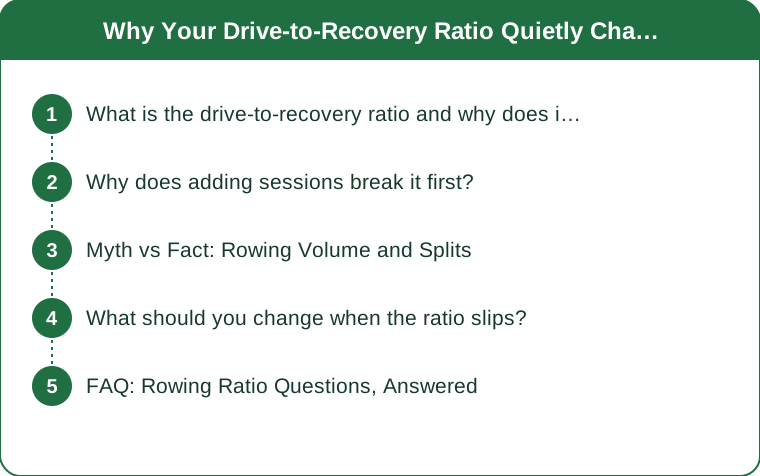
What is the drive-to-recovery ratio and why does it matter?
The drive is the working part of the stroke and the recovery is the slide back. In efficient rowing the recovery takes roughly twice as long as the drive, giving a ratio around 1:2. That ratio is where the stroke’s rhythm lives.
A shortened recovery raises stroke rate without raising power. You are simply doing the same work more often with less rest inside each cycle, which costs energy and returns nothing.
The ratio degrades before power does. Fatigue affects your ability to relax on the slide earlier than it affects your ability to push, so the rhythm goes first.
It is measurable without any extra equipment. Watch stroke rate alongside split. If rate has climbed two or three strokes per minute at the same split, the ratio has shifted.
And it explains the feeling of working harder for less. More strokes at the same output is genuinely more work for the same result, and your legs know it before the screen shows it.
Why does adding sessions break it first?
Recovery inside the stroke depends on being able to relax, and accumulated fatigue makes relaxation the first thing to go.
New volume lands before new adaptation. The first two to three weeks of a higher-volume block are the point of maximum fatigue and minimum benefit, which is exactly when the ratio deteriorates.
Technique holds under fresh conditions and slips under tired ones. If your rhythm was only just holding at two sessions a week, a third exposes it.
Sessions cluster badly. Three sessions in a week often means three in four days, which stacks fatigue rather than distributing it.
And people usually add intensity at the same time as volume. The third session is rarely an easy one, which doubles the load increase without anyone deciding to.

Myth vs Fact: Rowing Volume and Splits
Myth: Worse splits mean you are getting less fit. Fact: In the first weeks of added volume, worse splits usually mean accumulated fatigue, not lost fitness.
Myth: A higher stroke rate means you are working harder. Fact: It often means you are recovering less inside each stroke. Rate without power is cost without return.
Myth: You should push through a bad block. Fact: Ratio degradation is a signal to redistribute the load, not to add more.
Myth: More sessions always beat fewer. Fact: Three sessions you can complete with rhythm beat four that all degrade after the first ten minutes.
Myth: Split is the best measure of a session. Fact: Split paired with stroke rate tells you far more than split alone, because it separates efficiency from effort.
Myth: Technique work is separate from conditioning. Fact: Under fatigue they are the same problem, and rhythm is the part that breaks first.
What should you change when the ratio slips?
Add a rate cap rather than a split target for two weeks. Rowing at a fixed low rate forces the recovery phase to lengthen and rebuilds the rhythm directly.
Spread the sessions out. Three sessions across seven days beats three across four, and this alone resolves many cases.
Make one session genuinely easy. Easy means conversational, at a low rate, for time rather than distance.
Check the damper setting. A high damper with a short recovery is a fast route to this pattern, and lowering it often restores rhythm without any change to the plan.
Track rate and split together in a note, weekly. Two numbers, ten seconds, and you will see the pattern turn a week before you feel it.
And accept the two to three week lag. Adaptation to added volume takes longer than the fatigue takes to arrive, which is why the middle of the block always feels worst.
FAQ: Rowing Ratio Questions, Answered
What is a good drive-to-recovery ratio?
Roughly 1:2 for steady-state work, meaning the slide back takes about twice as long as the drive.
Why does my stroke rate creep up when I am tired?
Fatigue shortens the recovery phase before it weakens the drive, so the cycle gets faster without getting more powerful.
Should I lower the damper setting?
If your rate is climbing and your split is not improving, a lower damper often restores the rhythm. Most steady work sits well in the middle of the range.
How long before added sessions feel better?
Typically two to three weeks. The fatigue arrives before the adaptation, which is why the middle of a block feels worst.
Is it better to row more often or for longer?
More often, provided each session holds its rhythm. Sessions that degrade after ten minutes are training the wrong pattern.
How do I know if it is fatigue or bad technique?
If the rhythm is fine in the first ten minutes and gone by the twentieth, it is fatigue. If it is wrong from the first stroke, it is technique.
TL;DR:
- The recovery phase shortens under fatigue before the drive weakens, raising rate without raising power.
- Watch stroke rate alongside split; the pair shows problems a week before split alone does.
- Added volume produces its worst weeks two to three weeks in, before adaptation lands.
- Fix it with a rate cap, better spacing between sessions, and one genuinely easy row.
- A high damper with a short recovery accelerates the whole pattern.
- Rhythm that holds for ten minutes and fails at twenty is a fatigue problem, not a technique one.
Split tells you the result. Rate tells you what it cost.
Keep Reading
This article is for general informational and styling purposes only. Fit, sizing, and product availability may vary.