How to Set Your Damper and Drag Factor Without Guessing
Quick Answer: The damper lever controls how much air enters the flywheel housing, which changes how quickly the flywheel slows between strokes. It is not a resistance setting and it does not make the workout harder on its own. Drag factor is the machine’s actual measurement of that effect, and it is what you should set. Most people are best served by a drag factor between 110 and 130, which typically falls around damper 3 to 5 on a clean machine and higher on a dusty one. Check drag factor directly rather than trusting the lever number.
The lever number is the most misunderstood control in a gym, and setting it to ten is the most common self-inflicted rowing injury risk.
This blog has covered why your rowing numbers look worse on a different machine brand and why your split times look worse first thing in the morning. This is the setup guide that explains most of the machine-to-machine differences.

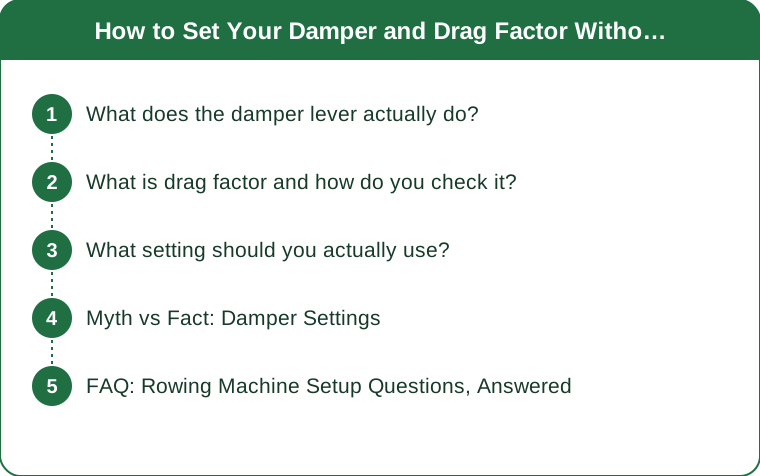
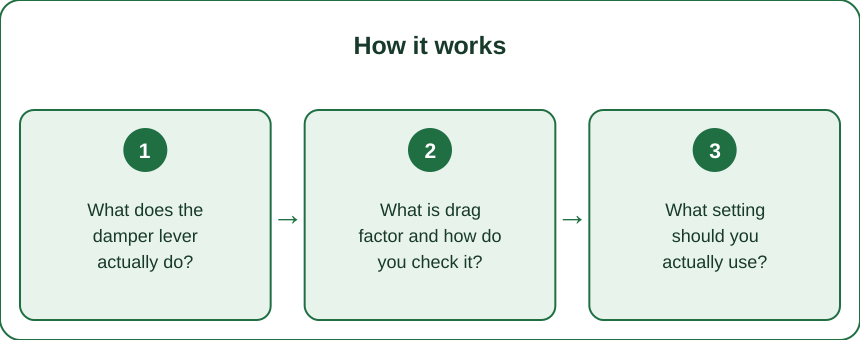
What does the damper lever actually do?
It opens and closes a vent on the flywheel housing, changing how much air the flywheel moves.
More air means more drag on the flywheel, so it slows faster between strokes. That changes the feel of the stroke, not the total work required for a given output.
Higher damper feels like rowing a heavy, slow boat. Each stroke has more load at the catch and the flywheel decelerates a lot before your next stroke, so you start each stroke from a lower speed.
Lower damper feels like a light, fast boat. Less load at the catch, and the flywheel is still moving quickly when you catch again, so the stroke is quicker and lighter.
Crucially, your split time depends on how much power you produce, not on the damper. You can produce identical splits at damper 3 and damper 8. The damper changes how that power is delivered, and therefore what gets fatigued and how much stress lands on your lower back.
This is why damper 10 is not a harder workout. It is a different workout, one with high load at the catch, which is exactly where most people’s technique breaks and where lumbar load is highest. It is not more effective, and for a beginner it is meaningfully riskier.
What is drag factor and how do you check it?
Drag factor is the machine’s own measurement of how fast the flywheel decelerates, and it is the number that is actually consistent between machines.
The damper lever is a mechanical position; drag factor is a measured result. A machine with a dusty flywheel housing produces a much higher drag factor at damper 5 than a clean machine does, because the dust restricts airflow in ways the lever position cannot account for.
On a Concept2, find it in the menu. From the main screen, go to More Options, then Display Drag Factor, then take ten to fifteen strokes. The number settles and that is your drag factor at the current lever position.
Set the number, not the lever. Once you know your target drag factor, move the lever until you hit it, and expect that lever position to be different on a different machine in the same room.
Typical targets: roughly 110 to 130 for most general fitness rowing, around 120 to 140 for larger or stronger athletes doing power work, and 90 to 110 for high-rate interval work where you want the flywheel to stay moving.
This single check explains most of the confusion around machine-to-machine differences. Two machines at damper 5 can differ by 30 or more drag factor points, which feels like an enormous difference in effort for what looks like an identical setting.
Other brands differ. Some machines use water or magnetic resistance where the same principle applies but the numbers do not transfer at all. If you switch brands, expect your splits to change and do not treat the two as comparable.

What setting should you actually use?
It depends on what the session is for, and the answer changes within a single week of training.
For steady aerobic work, go lower than feels natural. Drag factor around 105 to 120. Lower drag encourages a quicker stroke rate and less load per stroke, which is what you want for volume. Most people accumulate lower back fatigue on long pieces purely because their drag is too high.
For short, powerful intervals, higher is defensible. Drag factor 130 to 140 for pieces under two minutes lets you express more force per stroke. This is a specific tool for a specific session, not a default.
For technique work, go lower still. Drag factor around 100 makes bad technique very obvious, because a light flywheel punishes poor sequencing immediately. High drag masks technique errors by giving you something to pull against.
If you are new to rowing, start at 110 and stay there for a month. Getting your sequencing consistent matters far more than optimising the setting, and a fixed setting makes your split times comparable session to session while you learn.
Note the setting in your log. A split time without a drag factor is not comparable to another split time. This is the single most common reason people think they got slower when nothing changed except a different machine.
And if your lower back is the thing that limits your rowing, drop the drag factor first. Before changing technique, before adding core work, before anything else, lower the drag by 15 points and see what happens over two weeks. It is free and it resolves a surprising proportion of these cases.
Myth vs Fact: Damper Settings
Myth: Damper 10 is the hardest setting. Fact: Damper 10 is the setting with the most load per stroke. Your workout difficulty is determined by the power you produce, which you control entirely. You can make damper 3 brutally hard by rowing harder.
Myth: Damper 5 means the same thing on every machine. Fact: Airflow through the housing depends on how dusty the flywheel cage is. Two machines at damper 5 can differ by more than 30 drag factor points, which is a substantial difference in feel.
Myth: Elite rowers use high damper settings. Fact: Most competitive indoor rowers race at drag factors in the 115 to 135 range, which usually corresponds to a damper setting of roughly 3 to 5. High damper is far more common among beginners than among people who are fast.
Myth: Higher damper builds more strength. Fact: Rowing is not an effective strength stimulus at any damper setting. The loads are too low and the rep count too high. If you want strength, lift; the damper choice does not change that.
Myth: Low damper is for cardio and high damper is for power. Fact: Partly true for very short intervals, but far less than people think. Stroke rate and effort determine the training stimulus much more than the lever does.
Myth: You should find your setting once and never change it. Fact: Different sessions warrant different settings. Long steady work benefits from lower drag; short power intervals from higher. Treat it as a dial you adjust, not a preference you have.
FAQ: Rowing Machine Setup Questions, Answered
What damper setting should I use on a rowing machine?
Use drag factor rather than the lever, and target roughly 110 to 130 for general fitness rowing. On a clean Concept2 that usually falls around damper 3 to 5, but it varies with how dusty the flywheel housing is.
Is a higher damper setting a harder workout?
No. The damper changes how load is distributed within each stroke, not the total work. Your split time and effort determine difficulty. Damper 10 mainly increases catch load and lower back stress.
Why do my splits differ between two identical rowing machines?
Almost always drag factor. Dust in the flywheel housing changes airflow, so the same lever position produces different drag on different machines. Check drag factor on each machine and match the number, not the lever.
TL;DR:
- The damper controls airflow and stroke feel, not resistance. Your power output determines difficulty.
- Set drag factor, not the lever. Check it via More Options, Display Drag Factor, then row ten to fifteen strokes.
- Target roughly 110 to 130 for general work, 100 to 110 for technique and long steady pieces, 130 to 140 for short power intervals.
- Log drag factor alongside every split, or your times are not comparable across sessions or machines.
If your lower back is what limits your rowing, drop drag factor by 15 points for two weeks before changing anything else.
Keep Reading
This article is for general informational and styling purposes only. Fit, sizing, and product availability may vary.