Rowing Interval Workouts: The Erg Sessions That Build Your Engine Fast
Quick Answer: The best beginner rowing interval workout is 8 × 1 minute hard with 1 minute easy — 20 minutes total including warm-up. From there, the four sessions worth knowing are 4–6 × 500m with 90-second rests, 4 × 4 minutes with 3-minute recoveries, 10 × 30-second sprints, and a 1-2-3-2-1 minute pyramid. Run one or two of these a week, keep the damper at 3–5, and hold 24–28 strokes per minute.
The erg is the honest broker of cardio equipment. The screen shows your split in real time, it updates every stroke, and it doesn’t care how hard you feel like you’re working. Go out too fast on rep one and the machine will tell you about it on rep four, in numbers, with no mercy.
That’s exactly what makes it the best interval tool most gyms own.

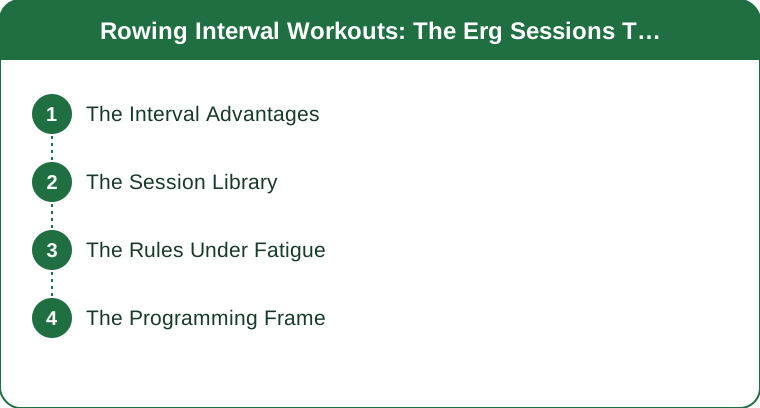
Why the rowing machine is so good for intervals
Full-body demand. The stroke sequence — legs, then back, then arms — recruits a large share of your total muscle mass. Bikes are legs. Treadmills are legs. The erg puts the posterior chain, the lats, and the quads into the same effort, which is why the calorie and cardio density per minute is so high.
Impact-free intensity. You can reach genuinely hard efforts with zero pounding through the joints. For anyone running-averse, injured, or carrying extra weight, this is the most accessible route to high intensity that exists.
Honest, immediate metrics. Split time (your pace per 500m) and watts are objective. You can’t talk yourself into believing a bad rep was good.
It scales to anyone. The same session structures work for a total beginner and a competitive rower — only the paces differ. The workouts below don’t need modifying by level.
One prerequisite: form first. Legs, then hips, then arms on the drive; arms, then hips, then legs on the recovery. Own that sequence at easy paces before you add intensity. Fast sloppy rowing trains bad patterns and produces cranky lower backs, and it isn’t faster anyway.
The five-session library
Session 1 — The beginner builder. 8 × 1 minute hard, 1 minute easy. About 20 minutes with warm-up and cooldown. “Hard” here means conversational-plus, not maximal — roughly a 7/10. This is the session to start with and to come back to after time off.
Session 2 — The classic 500s. 4–6 × 500m at strong effort, 90 seconds rest between. Rowing’s signature interval. The goal is split consistency: hit the same pace on rep 1 and rep 6. If rep 1 is five seconds faster than rep 5, you paced it wrong, regardless of how good rep 1 felt.
Session 3 — The engine builder (4 × 4). 4 × 4 minutes at comfortably hard, 3 minutes easy recovery between. This is the classic VO2 max protocol run on the erg. One of these a week is the single most efficient way to raise your aerobic ceiling.
Session 4 — Sprint day. 10 × 30 seconds near-maximal, 90 seconds rest. The power and speed tier. Earn this one — it’s for people with several months of consistent rowing behind them, because near-max effort is exactly where form breaks first.
Session 5 — The pyramid. 1 → 2 → 3 → 2 → 1 minutes hard, with matching rest after each. The variety session. It chunks mentally, which makes it feel shorter than it is. The 3-minute rung in the middle is the honest test of your pacing.

The rules that hold quality under fatigue
Restrain rep one. Deliberately. Pick your target split from a recent honest effort and hold it, even though rep one feels easy. The rep-one hero is a well-known figure at every rowing gym, and they’re always walking it in by rep four.
Cap the stroke rate at 24–28. Power comes from how hard you push with your legs, not from how frantically you slide. A rate cap functions as a technique governor: if you can’t hold the split at 26, the answer is a stronger drive, not a faster slide.
Damper 3–5, not 10. The damper is a gear setting, not a difficulty setting. High damper doesn’t make it better cardio — it makes each stroke heavier and slower and degrades your mechanics. Most people row best at 3–5.
Exhale on the drive. It’s the one breathing pattern that survives high intensity without you having to think about it.
Paddle easy in the recovery interval. Don’t slump over the handle. Light rowing between reps clears fatigue better and keeps the next rep honest.
End the rep when form leaves. The two fatigue tells are pulling with the arms before the legs finish, and lunging the back open early. When the stroke degrades, that rep is over — a shortened clean rep beats a full ugly one.
Myth vs Fact
Myth: Damper 10 is the “hard” setting for a real workout. Fact: Damper 10 mimics a heavy, slow boat. It’s not more cardio, it’s worse mechanics and more lower-back load. Competitive rowers mostly train at 3–5.
Myth: A higher stroke rate means a better workout. Fact: Rate without drive force just moves the handle quickly and produces mediocre splits. Watch the split, not the rate.
Myth: Rowing is an arm workout. Fact: Roughly 60% of the drive comes from the legs. If your arms are the limiting factor, your sequencing is off.
Myth: You should feel it in your lower back. Fact: You shouldn’t. Lower-back fatigue usually means you’re opening the back too early instead of finishing the leg drive first.
How to program intervals into your week
Frequency ceiling: one to two erg interval sessions a week. Intensity is a budget, not a virtue. Fill the rest with easy rows and other low-intensity cardio.
Placement: on fresh days. Leave roughly 48 hours between a hard erg session and heavy lower-body lifting, in either direction. Your legs can’t produce a good 500m split the day after a squat session.
Progression: add reps before dropping pace. Take 4 × 500 to 6 × 500 at the same split before you try to go faster. Volume first, intensity second.
Benchmark monthly. A 2k or 5k test every 4–6 weeks calibrates your target splits to your current fitness, so your intervals stay honest as you improve.
For runners: erg intervals are the ideal impact-free quality day, and they keep your engine intact through an injury layoff better than almost anything else.
A note on caution
Rowing intervals are vigorous exercise. Get clearance from a clinician before starting high-intensity work if you have cardiovascular risk factors or have been inactive for a long period. Stop for chest pain, dizziness, or unusual shortness of breath. Sharp lower-back pain during rowing is a technique signal, not something to push through — drop the intensity and get your sequencing checked.
FAQ
How long should a rowing interval workout be?
20–30 minutes of total session time including warm-up, for most of these formats. The 4 × 4 session runs closer to 35 minutes with warm-up and cooldown. Longer isn’t better with intervals — quality drops and you just accumulate fatigue.
What’s a good 500m split for intervals?
It’s individual, so calibrate from your own test rather than a chart. A practical method: take your recent 2k test split and add 2–4 seconds for 500m repeats, or 5–8 seconds for the 4-minute pieces. If you can’t hold it to the last rep, it was too fast.
Is rowing interval training better than steady rowing?
They do different jobs. Intervals raise your aerobic ceiling and are more time-efficient. Steady rowing builds the aerobic base and is far more sustainable in volume. One or two interval sessions on top of mostly easy work is the arrangement that produces the best results for most people.
TL;DR:
- Five sessions worth knowing: 8 × 1min builder, 4–6 × 500m, 4 × 4min, 10 × 30sec sprints, 1-2-3-2-1 pyramid.
- One to two interval sessions a week, on fresh days, 48 hours from heavy leg work.
- Damper 3–5, stroke rate 24–28, exhale on the drive.
- Restrain rep one — consistent splits beat a fast opener every time.
- Legs, then hips, then arms. When that sequence breaks, the rep is over.
- Progress by adding reps at the same split before chasing faster splits.
Keep Reading
This article is for general informational and styling purposes only. Fit, sizing, and product availability may vary.