The Rowing Machine Warm-Up Mistake That Makes the First 500 Meters Feel Awful
Quick Answer: Rowing engages the legs, back, and arms simultaneously in a coordinated sequence, and skipping a proper warm-up means those muscle groups and that coordination haven’t had time to activate — leading to a first 500 meters that feels disproportionately hard compared to the rest of a session.
A rough start on the rowing machine usually isn’t a fitness problem — it’s a warm-up problem, and a short one at that.

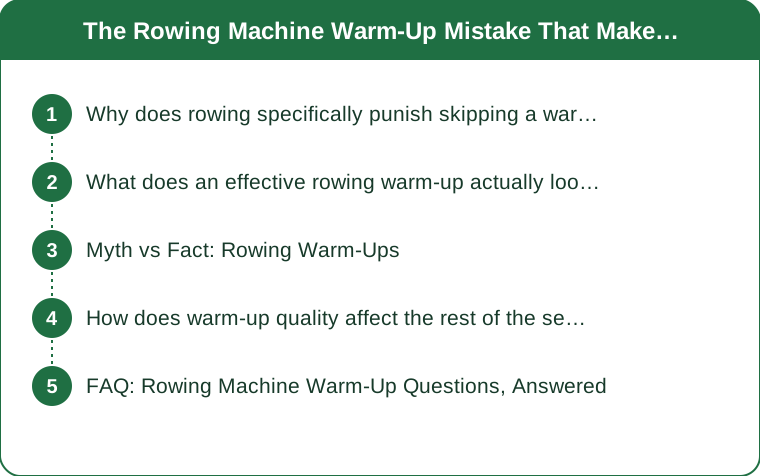
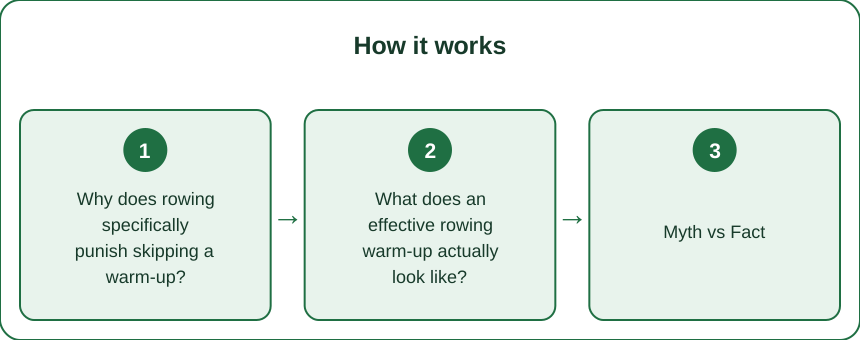
Why does rowing specifically punish skipping a warm-up?
Rowing requires the legs, core, and upper body to fire in a specific coordinated sequence on every single stroke, which is more complex than a single-muscle-group activity like cycling or a treadmill walk.
Cold muscles and unpracticed coordination together make the first several minutes disproportionately harder than they need to be, which often gets misread as poor fitness rather than a missing warm-up.
What does an effective rowing warm-up actually look like?
A short warm-up of 3 to 5 minutes at very light pressure and slow stroke rate lets the coordination pattern and major muscle groups activate gradually before adding real intensity.
Focusing the first minute purely on the sequencing — legs, then back, then arms on the drive, reversed on the recovery — rather than pace, sets up a much smoother transition into a harder effort.

Myth vs Fact: Rowing Warm-Ups
Myth: a rowing warm-up should be skipped for short workouts to save time. Fact: even short workouts benefit from a brief warm-up, since the first few minutes are exactly where the biggest form and comfort issues show up.
Myth: rowing is low-impact enough that a warm-up matters less than for running. Fact: the coordinated, full-body nature of the rowing stroke makes warm-up arguably more relevant, not less, compared to single-plane activities.
How does warm-up quality affect the rest of the session?
A properly warmed-up first few minutes generally leads to better stroke consistency and less early fatigue across the full session, since form issues from a cold start often persist if never corrected.
Skipping the warm-up and just pushing through discomfort in the first 500 meters also raises the risk of lower back strain, a common rowing injury tied to poor sequencing under fatigue or cold muscles.**
FAQ: Rowing Machine Warm-Up Questions, Answered
How long should a rowing warm-up be for a typical 20-30 minute session?
Around 3 to 5 minutes at light effort is usually enough before building into the main portion of the workout.
Should stretching happen before or after the rowing warm-up?
Dynamic movement is more useful before rowing; static stretching is generally better saved for after the session.
Does warm-up length need to increase for longer or more intense rows?
Somewhat — longer or higher-intensity sessions benefit from a slightly longer warm-up, closer to 5 to 7 minutes.
TL;DR:
- Rowing’s full-body coordination makes it especially warm-up sensitive
- A rough first 500 meters is usually a missing warm-up, not a fitness issue
- 3-5 minutes at light pressure and slow stroke rate is generally enough
- Skipping warm-up raises both discomfort and lower back strain risk
Give the first few minutes to coordination and light effort — the rest of the row goes noticeably smoother for it.
Keep Reading
This article is for general informational and styling purposes only. Fit, sizing, and product availability may vary.