The Anti-Desk Machine: How Rowing Undoes the Sitting Day
Quick Answer: Rowing is the one cardio machine whose main motion directly opposes desk posture. Every stroke finishes with the shoulder blades drawing together and the chest opening — roughly 600 of those in a 30-minute session. The benefit depends entirely on form: tall spine, legs driving first, handle to the lower ribs with proud shoulders.
The desk curls you forward for eight hours a day. The rowing machine pulls you back open, a thousand strokes at a time.
Of all the cardio options in a gym, rowing is the only one whose primary motion is the direct reverse of the sitting posture. It’s the anti-desk machine, and it’s usually the one nobody’s using.

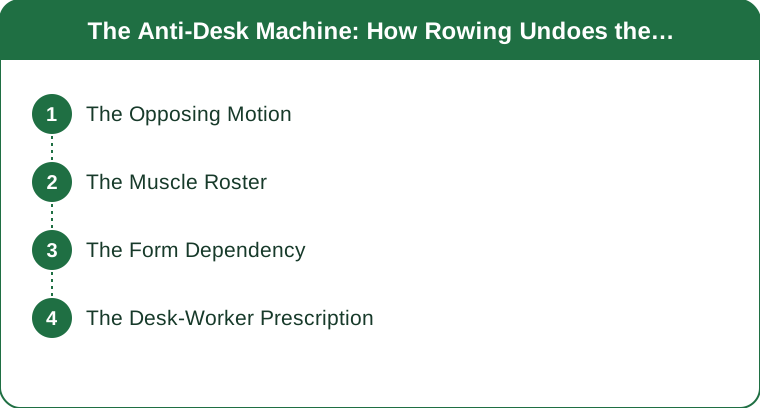
What Makes Rowing the Opposite of Sitting?
The finish position of every stroke.
Shoulder blades drawing together. Chest opening. Spine tall. Hips extended. That’s precisely the reverse of the keyboard hunch — rounded shoulders, closed chest, flexed hips, collapsed spine.
At a typical 20 strokes per minute, 30 minutes of rowing is around 600 posture repetitions. Not stretching, not passively resting the position — actively driving it, under load, six hundred times.
That’s the difference between pausing the desk damage and un-doing it.
Which Muscles Does It Actually Train?
The exact roster that every posture-correction program prescribes.
- Rhomboids and mid-traps — the muscles that retract the shoulder blades. These are what band pull-aparts are for; rowing loads them harder and more often.
- Rear deltoids — the back of the shoulder, chronically underworked in bodies that mostly push things.
- Spinal erectors — the muscles that hold you tall through the stroke.
- Glutes and hamstrings — hip extension, which is the direct antidote to hips shortened by sitting.
- Lats — the finish of the pull.
It’s a posture-corrective program disguised as cardio, which is a good disguise, because most people won’t do a posture program and most people will do cardio.

Does the Benefit Depend on Form?
Entirely. This is the catch, and it’s a real one.
Rowing with a rounded back doesn’t reverse the desk posture — it relocates it, adds load to it, and puts your lumbar spine under repeated flexion, which is genuinely worse than sitting.
The form rules, which are also the posture rules:
- Tall spine throughout. Chest up at the catch, ribs stacked over hips.
- Legs first. The drive sequence is legs → body → arms. Roughly 60% of the power comes from the legs.
- Handle to the lower ribs. Not the chest, not the belly. Elbows travel past your body.
- Proud shoulders at the finish. Blades together, shoulders down and back, slight backward lean of about 11 o’clock.
- Recovery reverses it. Arms → body → legs, slower than the drive. Roughly a 1:2 drive-to-recovery ratio.
One investment in learning the stroke, two returns: better rowing and better posture.
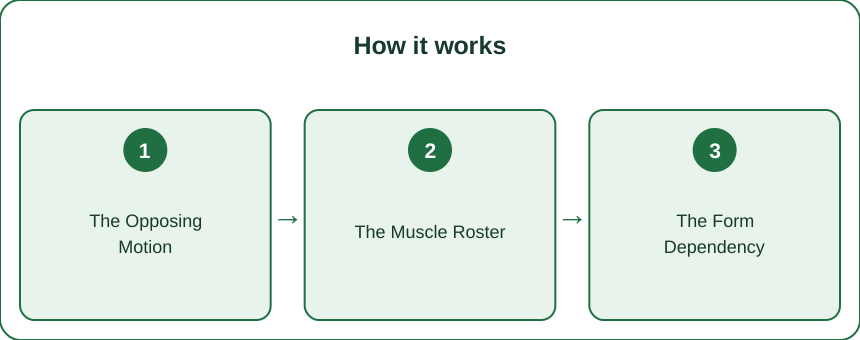
What’s the Prescription for a Desk Worker?
20–30 minutes, three times a week, moderate effort, deliberate posture.
That’s cardio banked and the day’s hunch reversed in the same session, which is a good deal on a schedule that doesn’t have room for both.
A simple structure to start:
- 5 minutes easy, focusing purely on the sequence
- 15 minutes steady at conversational effort, 20–24 strokes per minute
- 5 minutes easy
Keep the stroke rate low while you’re learning. A slow, powerful stroke is more correct and more useful than a fast, sloppy one — high stroke rate is the most common way form falls apart.
Compared to the alternatives: the treadmill is neutral on your posture — it ignores it. The bike is mildly negative, since you’re seated and leaning forward again. The erg is the one machine actively on your side.
5 Mistakes Everyone Makes
- Rounding the back. The one that turns a posture fix into a back problem. Chest up, always.
- Pulling with the arms first. Legs drive; arms finish. Reversing that order builds nothing and tires you fast.
- Rating too high too early. Stroke rate above 26 before the sequence is automatic guarantees sloppy form.
- Cranking the damper to 10. The damper is not resistance level — most people should row at 3–5. High settings load the back and slow the stroke.
- Rushing the recovery. The slide back should take roughly twice as long as the drive. Hurrying it is how the rhythm collapses.
FAQ
Is rowing bad for your back?
Rowing with poor form can be, because it repeatedly loads a flexed spine. Rowing with a tall spine is one of the better things you can do for a desk-bound back. Spend a session or two on the sequence before adding intensity.
What damper setting should I use?
Between 3 and 5 for most people. The damper adjusts airflow, not difficulty — it changes the feel of the stroke, not the resistance level, and high settings mostly encourage bad mechanics.
How often should I row for posture benefits?
Three sessions a week of 20–30 minutes is enough to feel a difference within a few weeks. Consistency matters more than session length here, since the benefit comes from accumulated repetitions.
Can rowing replace strength training for my back?
It’s a strong supplement, not a full replacement. It trains the postural muscles well, but you’ll still want some dedicated pulling and hip work for full coverage.
TL;DR:
- Rowing’s finish position is the exact reverse of desk posture
- 30 minutes ≈ 600 posture repetitions under load
- Trains rhomboids, mid-traps, rear delts, erectors, glutes — the posture roster
- The benefit depends completely on form; a rounded-back row is worse than sitting
- Sequence: legs → body → arms on the drive, arms → body → legs on the recovery
- Handle to the lower ribs, blades together, spine tall
- Damper 3–5, not 10; keep stroke rate low while learning
- 20–30 minutes, three times a week
The rowing machine was never just cardio. It’s the sitting day’s undo button — sold separately from the chair.
If you have an existing back condition or disc issue, get the stroke checked by a coach or physical therapist before adding volume. Sharp pain during the drive is a stop signal.
Keep Reading
This article is for general informational and styling purposes only. Fit, sizing, and product availability may vary.