Why Foot Stretcher Height Changes Your Rowing More Than Technique Cues Do
Quick Answer: The foot stretcher height on an erg changes the angle of your shins at the catch, which changes how far you can compress, how much your back has to round, and where the drive starts from. Most machines ship at a middle setting that suits a narrow band of body types. Moving it one hole in either direction changes your stroke more than most technique cues, and the correct setting is the one where your shins reach vertical at the catch without your heels lifting excessively.
It takes ten seconds to change and almost nobody does.

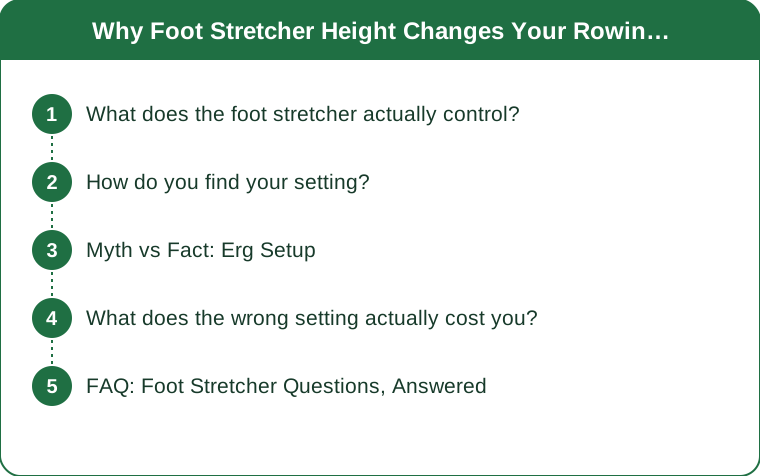
What does the foot stretcher actually control?
The relationship between your heel height and the seat, which sets your compression geometry.
On a standard erg, the foot plate can be moved up and down through several positions. Higher plate means your heels sit higher relative to the seat; lower plate means they sit lower.
This changes one critical thing: how much you can compress at the catch before something has to give.
With the plate set too high, your knees come up very high at full compression. Your torso runs out of room, your shins pass well beyond vertical, and your lower back has to round to fit. The catch becomes cramped, and the drive starts from a position where your legs cannot produce much force.
With the plate set too low, your heels are further from your seat. You can compress comfortably, and you may not be able to reach a strong catch angle at all — your shins stop short of vertical and you leave stroke length behind.
The target is shins roughly vertical at the catch, with your heels lifting slightly but not dramatically, and your back able to hold a neutral or near-neutral position.
The reason this beats most technique cues is simple. A cue asks you to achieve a position; the setup determines whether that position is available. You cannot cue your way out of a geometry problem.
How do you find your setting?
A three-minute process you do once and then remember.
Start where you are. Note the current hole number so you can return to it.
Row twenty easy strokes and stop at the catch. Hold the compressed position and look down at your shins. Are they vertical? Past vertical? Short of it?
If your shins pass well beyond vertical and your back is rounding, the plate is too high. Move it down one hole.
If your shins stop noticeably short of vertical, the plate is too low. Move it up one hole.
Row twenty more strokes and check again. Change one hole at a time. The differences are larger than you expect.
A second check worth running: at the catch, how much of your heel is off the plate? Some heel lift is normal and expected. If your heels are barely on the plate at all, you are too high. If they never leave the plate, you may be leaving compression on the table.
The general pattern: taller rowers and those with longer legs relative to torso usually need a lower plate. Shorter rowers and those with limited ankle dorsiflexion often need it higher. Limited ankle mobility is the most common reason someone needs a setting different from the default, and it is worth knowing about yourself.
One more variable people forget entirely: where the strap sits on your foot. It should cross the ball of the foot, not the arch or the toes. A strap too high restricts your ankle; too low and your foot slides.

Myth vs Fact: Erg Setup
Myth: the default setting is designed for most people. Fact: the default is the middle of the range, chosen so that a machine out of the box works acceptably for the widest population. Acceptable is not optimal, and the middle setting genuinely fits a minority well.
Myth: foot height only matters for elite rowers. Fact: it matters more for beginners, because a bad geometry produces exactly the technique faults beginners are told to fix — early back opening, rounded lumbar spine, weak leg drive. You can spend months working on a fault caused by a hole position.
Myth: if you can reach a good catch, the height is fine. Fact: you can reach a good catch from a bad setting by compensating, and the compensation costs you power and adds load to your back. Reachable and sustainable are different standards.
Myth: the damper setting matters more. Fact: damper matters for how the stroke feels and for drag factor, and it does not change your geometry. Foot height changes what positions your body can access. Geometry beats feel.
Myth: you should keep your heels down throughout. Fact: heel lift at the catch is normal on an erg and is a function of ankle mobility and plate position. Forcing your heels flat generally means shortening your stroke.
Myth: once set, it never changes. Fact: it changes with footwear. Rowing in thick-soled trainers versus flat shoes versus socks meaningfully alters the effective height, which is why your stroke feels different when you change shoes.
What does the wrong setting actually cost you?
Three specific things, all of which get misdiagnosed as technique problems.
Stroke length. A plate too low costs you catch angle, which costs you the distance the handle travels, which costs you work per stroke. On a 2k, a small reduction in effective stroke length compounds across several hundred strokes into a meaningful time difference. People chase this with higher stroke rates, which is the expensive way to solve it.
Back position. A plate too high forces lumbar flexion at the catch to make room for the torso between the thighs. This is the single most common source of the lower back discomfort that people attribute to weak core or bad posture. Sometimes the core is fine and the geometry is wrong.
Leg drive quality. The first part of the drive should be legs, with the back holding its angle. From an over-compressed catch, the legs are at a mechanically poor angle and cannot contribute much, so the back opens early to generate force. That produces the classic pattern of shooting the tail — seat moving away faster than the handle.
Each of these is normally addressed with coaching cues. Sometimes cues are the right answer. When someone has heard the same correction for months without it sticking, the setup is worth checking before the technique.
One more cost that is harder to measure: consistency between machines. If you row at a gym and use whichever erg is free, you may be rowing a different geometry every session without realizing it. Checking the hole number before you start takes five seconds and removes a variable you were unknowingly training around.
FAQ: Foot Stretcher Questions, Answered
What number should I use?
There is no universal answer, which is exactly the point. Run the shin-angle check and adjust from there. If you want a starting bias, taller rowers usually go lower than default and shorter rowers usually go higher.
Should I row in shoes or socks?
Either works. Flat, thin-soled shoes give the most consistent connection and a predictable effective height. Thick running trainers add height and compress under load, which makes the drive feel slightly mushy. Whatever you choose, be consistent, because switching changes your setting.
My heels always lift at the catch. Is that wrong?
No. Some heel lift is normal and reflects ankle mobility. Heels lifting so much that only your toes are engaged suggests the plate is too high or your ankle mobility is limiting you — the latter is worth working on separately.
Does this apply to water rowing too?
The principle is the same but the adjustment is different, since boat foot stretchers adjust for both height and rake. If you row on water, this is a conversation worth having with your coach — it is more consequential there than on an erg.
TL;DR:
- Foot stretcher height sets your catch geometry, which determines whether a good position is even available to you.
- Target shins roughly vertical at the catch with slight heel lift and a back that can hold neutral.
- Too high forces lumbar rounding and a weak leg drive; too low costs stroke length.
- Change one hole at a time, check the hole number on shared machines, and stay consistent with footwear.
Before your next session, stop at the catch and look at your shins. If they are not close to vertical, the fix is a hole position, not another month of technique cues.
Keep Reading
This article is for general informational and styling purposes only. Fit, sizing, and product availability may vary.