Why Rowing Machine Form Most Often Breaks Down at the Very Start of the Stroke, Not the Finish
Quick Answer: Rowing form usually breaks at the catch — the start of the stroke — not at the drive, because the catch has to be rebuilt from scratch every single stroke while the drive is largely momentum. Fatigue erodes that setup first, but you only see it during the drive. Reset shin angle and full arm extension every 5–10 strokes to catch the problem at its source.
Twelve minutes in, everything feels fine. Twenty minutes in, your lower back is complaining and your splits are drifting.
The instinct is to fix the drive, because that’s where it hurts. The drive is downstream. The problem started about a tenth of a second earlier.

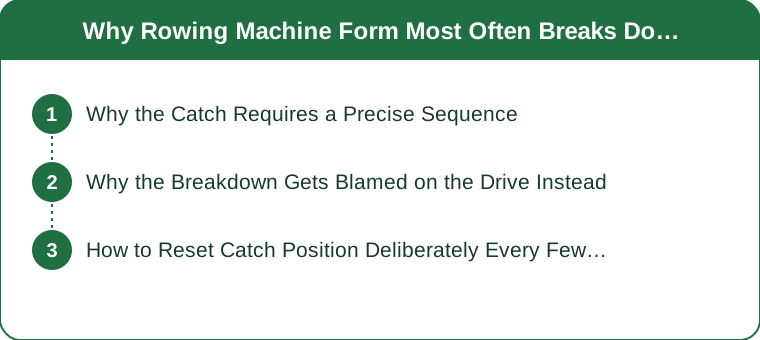
Why Is the Catch the Hardest Part of the Rowing Stroke?
Because it’s the only part you have to build from nothing, every stroke, several hundred times a session.
A good catch requires several things to be true simultaneously:
- Shins vertical or close to it — going past vertical shortens your effective drive and jams the knees
- Arms fully extended, shoulders relaxed — not pulling yet, not hunched
- Torso at roughly the 1 o’clock position, hinged from the hips
- A flat, braced spine — not rounded at the lumbar
- Heels down or lightly lifted, ready to press
The drive, by contrast, is largely a chain reaction. Once the catch position is right and you press with the legs, the sequence — legs, then back, then arms — mostly executes itself. It’s powerful, but it’s not technically fragile.
At a typical 24–28 strokes per minute, that means you’re reconstructing the most demanding position in the stroke roughly 1,500 times an hour. The recovery phase gives you about a second to do it. That’s the fragile point, and fatigue finds it first.

Why Do Rowers Blame the Drive Instead?
Because the drive is where the failure becomes visible and where you feel the strain.
When the catch degrades — shins overcompressed, back rounded, arms slightly bent — you don’t notice at the catch. The position lasts a fraction of a second and you’re not looking at it. What you notice is what happens next: the drive feels weak, the back takes load it shouldn’t, the split number rises.
So you correct the drive. You pull harder with the arms, you open the back earlier, you try to muscle it. All of which are compensations for a setup problem, and most of which make the loading worse.
The three most common catch-driven failures:
- Overcompression — sliding too far forward so the shins pass vertical. Steals range and stresses the knees.
- Early back opening (“shooting the tail”) — the seat moves but the shoulders don’t, so the legs finish before the back engages. This is a rounded-lumbar risk.
- Bent arms at the catch — pulling with the biceps before the legs have pressed, which is both weak and a common cause of forearm fatigue.
Every one of those originates in the setup and gets diagnosed during the pull.
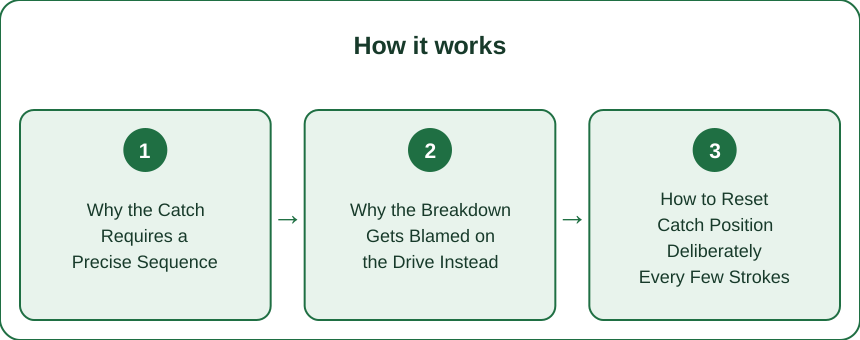
How Do You Fix Your Catch Position on the Rowing Machine?
Check it deliberately and on a schedule, rather than waiting to feel something wrong.
Every 5–10 strokes, run a two-item check: shins vertical? arms straight? That’s it — two things, half a second, and it catches the drift before it compounds.
Use these drills:
- Pause drills. Pause for one second at the catch, every stroke, for 10 strokes. It’s slow and it makes the position conscious. Do this at the start of every session as part of your warm-up.
- Legs-only rowing. Row using just the leg press, arms straight and back still, for 20 strokes. It removes everything except the setup and the leg drive.
- Film yourself from the side for 60 seconds. A phone propped on a bench, filming your side profile, will show you more in one minute than a month of feeling for it. Look specifically at shin angle at the front end.
Watch your stroke rate. Drifting up to 30+ spm on a steady piece usually means you’re shortening the recovery, which means less time to build the catch. Slowing to 22–24 spm and pulling harder often fixes form problems that no cue was fixing.
Reset when fatigue hits, don’t push through. Ten seconds of paused strokes mid-piece costs almost nothing and re-establishes the pattern. Grinding out the last five minutes with a collapsing catch is where lower back strain comes from.
What Nobody Tells You About Damper Settings
A high damper feels like “harder” and therefore like “better training.” It’s a common cause of catch breakdown in beginners.
Damper controls airflow into the flywheel — how the resistance feels, roughly analogous to gearing on a bike. A very high setting increases the load at the catch specifically, which is the exact moment your position is most vulnerable. Most rowing coaches recommend 3–5 for general training, not 10, and most competitive rowers train in that range too.
If your form falls apart late in a piece, dropping the damper two points is a faster fix than any cue.
FAQ
What is the correct catch position on a rowing machine?
Shins vertical (not past), arms fully extended with relaxed shoulders, torso hinged forward from the hips to roughly the 1 o’clock position, back flat rather than rounded, and heels ready to press. If you can’t reach that position without rounding your lower back, work on hip and ankle mobility rather than forcing the range.
Why does my lower back hurt when rowing?
Most commonly because the back is opening before the legs have driven, which loads a flexed lumbar spine — and that sequencing error is nearly always set up by a poor catch position. Filming from the side and doing legs-only drills addresses the cause; if pain persists or is sharp rather than fatigue-related, see a physical therapist.
How do I know if my rowing form is breaking down?
Watch your split times at a constant effort — if they drift while your perceived effort stays the same or rises, form is degrading. Rising stroke rate at the same pace is the other reliable tell, since it usually means you’re shortening the stroke rather than driving it.
General fitness information, not medical advice. Persistent or sharp back pain during rowing warrants assessment by a healthcare professional.
TL;DR:
- The catch is rebuilt from scratch ~1,500 times an hour; the drive is largely a chain reaction, so the catch fails first
- The failure becomes visible during the drive, so people correct the wrong phase and make loading worse
- Three catch failures cause most problems: overcompression, early back opening, bent arms
- Check two things every 5–10 strokes: shins vertical, arms straight
- Use pause drills, legs-only rowing, and a 60-second side-profile video; keep the damper at 3–5, not 10
Keep Reading
This article is for general informational and styling purposes only. Fit, sizing, and product availability may vary.