Why the Damper Setting Is Not a Difficulty Knob and What It Actually Changes
Quick Answer: The damper controls how much air enters the flywheel housing, which sets how quickly the wheel slows down between strokes — the drag factor. It is a gearing choice, not a difficulty level. Higher settings make each stroke feel heavier and slower, like a heavy gear on a bike; lower settings feel lighter and faster. Intensity comes from how hard you drive, at any setting. Most people row best somewhere in the 3 to 5 range, which typically lands near a drag factor of 105 to 130 — and the number on the lever means nothing until you check it against the drag factor on the monitor.
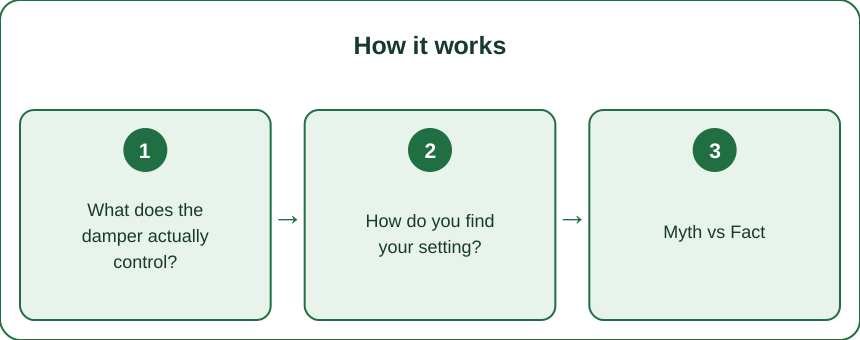
Here is what the setting actually does, and how to find yours in three minutes.

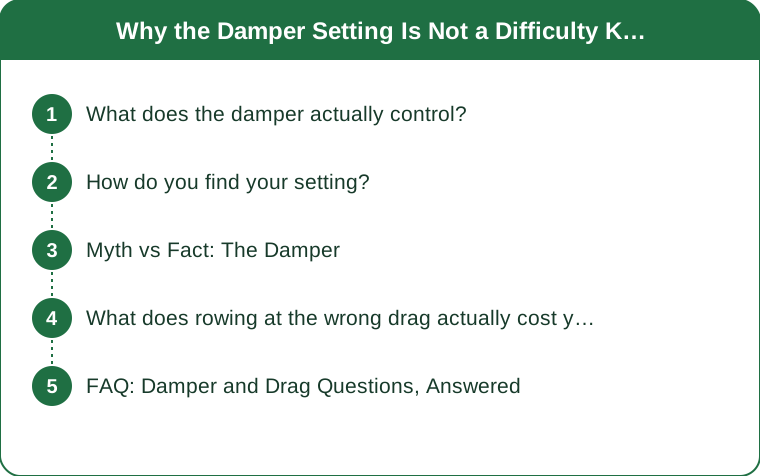
What does the damper actually control?
Airflow into the flywheel cage, and through it, how fast the wheel decays between strokes.
A rowing erg is an air-braked machine. When you drive, you spin the flywheel; between strokes, air resistance slows it down. The damper is a vent. Open it to 10 and the housing gulps air, braking the wheel hard between strokes. Close it to 1 and the wheel keeps spinning with little loss.
The machine measures this decay directly and reports it as drag factor — visible in the monitor menu. Drag factor is the real number. Damper position is just a lever, and the same lever position produces different drag on a dusty machine versus a clean one, or between two machines of different ages. Damper 4 on one erg can be damper 6 on another. This is why serious rowers set by drag factor and ignore the lever number.
What the setting changes about your stroke is the shape of the work.
At high drag, the wheel has slowed a lot by the time you catch, so the start of the drive feels heavy — closer to a deadlift. The stroke is slower, more muscular, more load per stroke.
At low drag, the wheel is still spinning when you catch, so connection feels lighter and the stroke rewards speed and timing — closer to cycling in an easy gear at high cadence.
Neither is harder. A 500m sprint at damper 2 and at damper 9 can cost identical wattage. What changes is which system carries the load: high drag biases muscle and per-stroke force, low drag biases rhythm, rate, and cardiovascular flow.
How do you find your setting?
Set by drag factor, confirm by feel, and let your session goal adjust it.
Step one: display drag factor. On a Concept2 monitor it lives under More Options, then Display Drag Factor. Row a few strokes and the number appears.
Step two: land in a sensible band. For most women rowing for fitness, a drag factor around 105 to 125 is the productive zone. Lightweight and smaller rowers often sit near the bottom of that band; taller, stronger rowers toward the top. On a clean machine that is usually damper 3 to 5. On-the-water rowers train even lower to mimic boat feel.
Step three: row two minutes and audit the stroke. At the right drag, you feel immediate connection at the catch — the handle loads as soon as you push — and you can hold a rate of 22 to 26 without rushing. Signs you are too high: the catch feels like yanking a stuck drawer, your split fades badly in the second half, your lower back grumbles. Signs you are too low: you feel like you are spinning without purchase and the only way to raise the split is frantic rate.
Step four: match drag to the day. Short power pieces tolerate slightly higher drag. Long steady rows and anything over twenty minutes belong at moderate drag, where the per-stroke load is sustainable. Racing a 2k at the drag you use for 10-stroke power work is a classic self-sabotage.
One comfort note while you are at the machine: fitted bottoms — biker shorts or snug leggings — are worth wearing on the erg specifically because loose fabric bunches under you on the sliding seat and catches at the top of the drive. It is the one machine in the gym where the baggy option actively interferes.

Myth vs Fact: The Damper
Myth: damper 10 is for advanced rowers. Fact: elite rowers mostly train between roughly 100 and 135 drag factor — damper 3 to 5 on most machines. Maximum drag is a specialty tool for short power work, not a rank you graduate into. Walking past a row of ergs all parked on 10 tells you nothing except that nobody checked.
Myth: higher damper burns more calories. Fact: calories track wattage, and wattage is how hard you drive, not where the vent sits. A hard 30 minutes at damper 3 out-burns a grinding 30 minutes at damper 8 that forces you to slow down — which it usually does.
Myth: low damper is cheating. Fact: the monitor cannot be cheated. It measures the wheel’s actual acceleration and decay and computes your true work. A fast split at damper 2 is exactly as real as the same split at damper 8.
Myth: the damper number transfers between machines. Fact: dust and wear change airflow, so identical lever positions give different drag on different machines. Drag factor is the portable number; the lever is not.
Myth: heavier drag builds more muscle. Fact: slightly more muscular emphasis per stroke, yes — but an erg is not a strength tool at any setting, and the cost of high drag is stroke quality and back fatigue. If you want strength, lift. If you want erg fitness, row at a drag you can hold form at.
Myth: changing the damper mid-workout is fiddling. Fact: adjusting between intervals to match the piece — a notch up for 10-stroke sprints, back down for steady work — is exactly how the tool is meant to be used.
What does rowing at the wrong drag actually cost you?
Three things, and all of them get misread as fitness problems.
Too high costs you the second half of every piece. Heavy per-stroke load recruits more muscle early, and muscular fatigue arrives before cardiovascular fatigue would have. The signature is a strong first 500m and a fading, grinding finish — which people interpret as poor endurance when it is actually poor gearing. Drop the drag and the same fitness suddenly holds its split.
Too high also loads the back at the worst moment. A heavily braked wheel at the catch demands peak force in the most flexed position of the stroke. Tired rowers at high drag start opening the back early to move the load, and that pattern — not rowing itself — is where most erg-related back complaints come from.
Too low costs you connection and teaches rushing. With the wheel spinning freely, lazy timing goes unpunished, and the only route to a better split is spinning the rate up. Rowers who live at very low drag often develop a quick, shallow stroke that collapses the moment they meet real resistance.
The deeper cost is diagnostic: you cannot evaluate your own progress if the gearing changes every session. Pick a drag factor, note it, and test at the same number every time. A 2k done at drag 115 in June and drag 140 in August is not a comparison — it is two different sports.
Check the drag factor before every session on a shared machine. It takes ten seconds, and someone before you definitely moved the lever.
FAQ: Damper and Drag Questions, Answered
What drag factor should a beginner start at?
Around 100 to 115. It is enough resistance to feel the catch connect without turning every stroke into a lift. Spend your first month there learning sequence — legs, then back, then arms — before experimenting.
Why does the same split feel harder some days at the same damper?
First suspect the machine: dust builds and drag drifts, so check the drag factor number rather than the lever. If drag matches, the variable is you — sleep, heat, and hydration move erg performance more than people expect, especially in late summer.
Should I raise the damper to train for a race?
Train mostly at your race drag. Sprinkling in short high-drag power strokes is a legitimate tool, but racing rewards the stroke you have practiced, and a 2k at unfamiliar gearing falls apart in the third 500 on schedule.
Does the fan direction or foot strap tightness interact with this?
Not the fan, but straps slightly, yes — at lower drag with higher rates, snug straps help the quick catch; heavy low-rate work can even be done strapless to audit your connection. If strapless rowing sends you flying, your drag may be higher than your technique.
TL;DR:
- The damper is an air vent that sets drag factor — the gearing of your stroke — not a difficulty dial. Intensity comes from you.
- Set by the drag factor number on the monitor, not the lever: around 105 to 125 suits most women, damper 3 to 5 on a clean machine.
- Too high drag fades your second half and loads the back at the catch; too low teaches a rushed, unconnected stroke.
- Keep your test pieces at one fixed drag factor, and check it on every shared machine before you row.
Next session, pull up the drag factor display before you touch the handle. The lever has been lying to you; the number does not.
See It in Motion
Seen here: Super High Waist Embossed Yoga Leggings with Inner Pocket — shop it on bubblelime.com
Keep Reading
This article is for general informational and styling purposes only. Fit, sizing, and product availability may vary.