Why Your Drive to Recovery Ratio Matters More Than Your Stroke Rate
Quick Answer: The rowing stroke has a fast, powerful drive and a slower, controlled recovery - and the ratio between them, roughly 1:2 at steady state, is what determines whether you can sustain a pace. Stroke rate is an output of that ratio, not an input you should chase directly. Rushing the recovery raises your rate, shortens your recovery time, and reduces power per stroke simultaneously - which is why pulling harder at a higher rate so often produces a worse split.
Here is what each phase should actually feel like, and how to fix a rushed recovery.

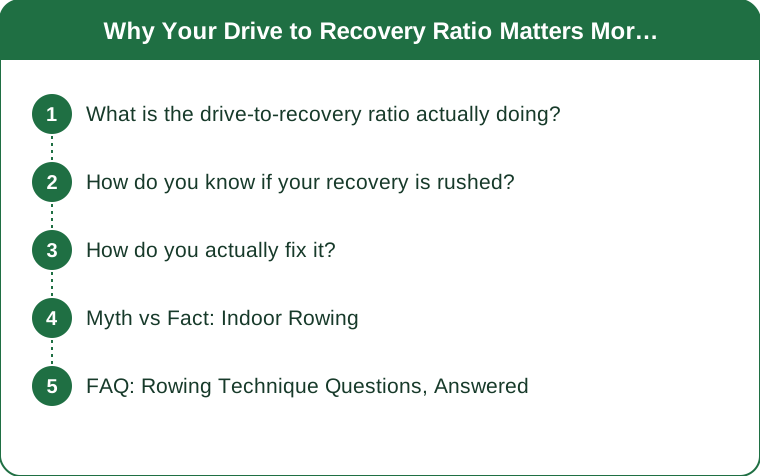
What is the drive-to-recovery ratio actually doing?
It controls two things at once: how much force each stroke produces, and how much recovery you get between efforts.
The drive is where all the power happens - legs, then back, then arms, in that sequence, over a short time window. Force production is brief and intense.
The recovery is a genuine rest interval, and this is the part people misunderstand. Arms away, body over, then legs. The muscles that just produced force are unloaded, and blood flow through them improves. At a 1:2 ratio, roughly two-thirds of every stroke cycle is recovery - which is what makes a 20-minute piece possible at all.
Shorten the recovery and you shorten the rest. A rushed recovery at the same drive intensity means less time to recover between efforts, so fatigue accumulates faster at the same apparent output.
And a rushed recovery costs you power on the next stroke. Arriving at the catch too quickly means arriving without control - the body is still moving when it should be changing direction, which produces a weak, hurried connection at the front end. This is the single biggest source of lost power on an erg.
The rate follows the ratio. Slow the recovery and the rate drops naturally. Trying to lower your rate by pulling slower on the drive is backwards - it reduces power without giving you any more recovery, which is the worst of both.
How do you know if your recovery is rushed?
Several signals, and most are visible without any data.
The clearest is the split-to-rate relationship. If your rate climbs while your split stays the same or worsens, your recovery is shortening and your power per stroke is falling. Two people at the same split, one at 22 strokes per minute and one at 30, are not doing the same thing - and the one at 22 is producing considerably more power per stroke.
The catch feels hurried or jarring. A controlled catch feels like a smooth change of direction; a rushed one feels like an impact. If there is a bump at the front end, you arrived too fast.
The handle speed on the recovery is uneven. Watch it - it should move at a steady, unhurried pace. Most rushed rowers accelerate as they approach the catch, which is exactly backwards.
Your rate climbs as you fatigue. This is nearly universal and it is a compensation. As power drops, the instinct is to row faster to maintain the split, which shortens recovery further and accelerates the decline. A rate that rises through a piece is a fatigue signature, not a strategy.
And breathing falls out of sync. At sustainable rates, breathing typically settles into a pattern with the stroke. When the recovery is rushed, there is not enough time in the cycle and the breathing becomes hurried and shallow - which you can feel long before the numbers show it.
A simple test: count during a stroke. One count for the drive, two counts for the recovery. If you cannot fit two counts into the recovery without feeling hurried, the ratio has slipped.

How do you actually fix it?
Fix the sequence first, then the ratio, then the rate.
Get the recovery sequence right: hands away, body over, then legs. Breaking the knees before the handle passes them forces the handle to travel around the knees, which disrupts the whole rhythm. This single error accounts for a large share of rushed recoveries.
Practise at a deliberately low rate. Pieces at 18 to 20 strokes per minute with full power on the drive. This forces a long recovery and teaches what the ratio should feel like - and it is genuinely hard work, which surprises people.
Use the pause drill. Row with a full pause at hands-away, then at body-over. Pauses make it impossible to rush and expose exactly where the sequence breaks down.
Set the rate cap deliberately in workouts. A piece with a rate ceiling - hold this split at no more than 22 - trains power per stroke rather than turnover, and it is the single most effective structure for someone whose rate climbs under fatigue.
Then let the rate rise only with intensity. Higher rates are correct for shorter, harder pieces. The problem is not a high rate; it is a high rate compensating for lost power.
And check the damper setting while you are at it. A very high damper does not mean harder training - it changes the feel of the stroke toward a heavier, slower drive, and most people are better served in the middle range where technique holds up. Damper is not resistance in the way people assume.
This is general information, not medical advice. If you have a back condition or you get pain rather than fatigue while rowing, get a qualified coach to look at your technique - rowing rewards good sequencing and punishes poor lumbar mechanics more than most machines.
Myth vs Fact: Indoor Rowing
Myth: A higher stroke rate means a harder workout. Fact: Rate is turnover, not intensity. You can row at a high rate with very little power - and low-rate, high-power work is frequently the harder session.
Myth: Damper 10 is the hardest setting. Fact: The damper changes the drag characteristic and the feel of the stroke, not simply how hard it is. Most rowers train well in the middle of the range, and a high damper often degrades technique before it improves fitness.
Myth: Rowing is an upper body exercise. Fact: The legs produce the majority of the power in the drive. If your arms and back are the first thing to fatigue, the sequencing is wrong, not your upper body strength.
Myth: The recovery is rest, so it does not matter how you do it. Fact: It is rest and it is preparation. The recovery determines the quality of the next catch, which determines how much power the next stroke can produce.
Myth: You should pull the handle to your chest as hard as possible. Fact: The finish is the smallest contributor to the stroke. Over-emphasising the arm pull typically costs leg drive and adds nothing to the split.
The one that surprises people: slowing down the half of the stroke where you are not working usually makes your splits faster. It gives the legs more recovery and the catch more control, and both show up as power on the next drive.
FAQ: Rowing Technique Questions, Answered
What should my drive-to-recovery ratio be?
Roughly 1:2 at steady state - the recovery should take about twice as long as the drive. It shortens naturally toward 1:1 at sprint intensities.
What stroke rate should I row at?
For steady work, most people do well between 18 and 24 strokes per minute with strong drives. Higher rates belong to shorter, harder pieces rather than being a target in themselves.
Why does my split get worse when I row faster?
Because raising the rate usually shortens the recovery, which reduces both your rest and the control of your catch. Less power per stroke at a higher rate is a net loss.
What is the correct recovery sequence?
Hands away, body over, then legs. Breaking the knees before the handle passes them forces the handle around the knees and disrupts the entire rhythm.
What damper setting should I use?
The middle of the range suits most people. A high damper changes the stroke’s feel toward a heavier, slower drive rather than simply making the workout harder, and it often degrades technique.
Why does my rate creep up during a long piece?
It is a fatigue compensation - as power per stroke drops, you row faster to hold the split. Setting a rate ceiling for the piece trains you out of it.
TL;DR:
- The stroke is a fast drive and a slower recovery, roughly 1:2 at steady state - the recovery is genuine rest, not dead time.
- Rate is an output of the ratio, not a target. Rushing the recovery cuts your rest and your next catch at the same time.
- Diagnose a rushed recovery by: rate climbing while split holds, a jarring catch, handle accelerating toward the front, breathing falling out of sync.
- Fix the sequence first - hands away, body over, then legs - before anything else.
- Train it with low-rate pieces (18 to 20), pause drills, and rate-capped workouts.
- Legs produce most of the power. Arms and back fatiguing first means the sequencing is wrong.
- Middle damper settings usually beat high ones - damper changes the stroke’s feel, not simply its difficulty.
Slowing down the half where you are not working is what makes the half where you are working count.
This is general information, not medical advice.
Keep Reading
This article is for general informational and styling purposes only. Fit, sizing, and product availability may vary.