Why Your Rowing Machine's Monitor Numbers Don't Always Match How Hard the Row Actually Feels
Quick Answer: Damper setting, stroke technique consistency, and even how recently the flywheel was cleaned all affect what split time and wattage the monitor reports for a given amount of physical effort, meaning two sessions that felt identically hard can show meaningfully different numbers for reasons that have nothing to do with your fitness that day.
It’s a genuinely disorienting experience — a session that felt like your hardest effort in weeks shows a mediocre split time, while an easier-feeling session posts a personal best.

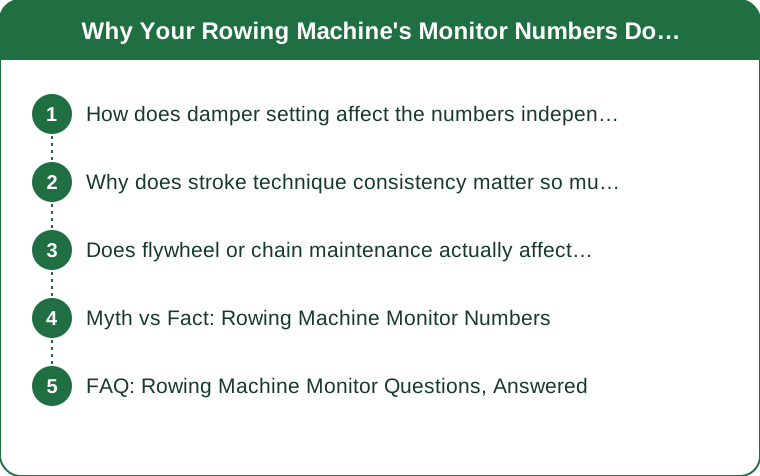
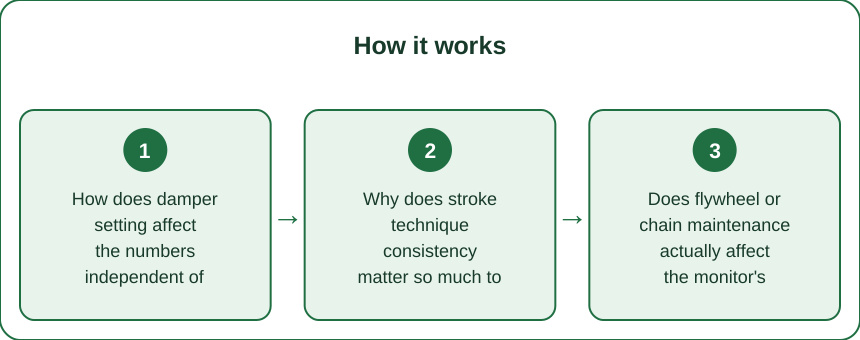
How does damper setting affect the numbers independent of effort?
The damper controls how much air resistance the flywheel encounters, and a higher damper setting requires more force per stroke but doesn’t necessarily produce a proportionally faster split time — it changes the feel of resistance more than it directly changes the output number, which is why comparing splits across different damper settings is misleading.
Why does stroke technique consistency matter so much to the numbers?
A powerful, well-timed drive phase generates more flywheel momentum per stroke than the same physical effort delivered with inconsistent timing or a rushed recovery phase, meaning two rows with identical perceived effort can produce different power output numbers purely based on technique efficiency that day.

Does flywheel or chain maintenance actually affect the monitor’s readings?
Yes — a flywheel with accumulated dust or a chain needing lubrication creates additional friction that the monitor doesn’t account for in its calculation, meaning the same effort produces a slightly worse-looking number on a machine that hasn’t been cleaned recently compared to a well-maintained one.
Myth vs Fact: Rowing Machine Monitor Numbers
Myth: Split time and wattage are a direct, reliable measure of effort on any given day. Fact: Damper setting, technique, and machine maintenance all influence the number independent of actual physical effort.
Myth: A worse split time than usual always means you’re less fit that day. Fact: It often reflects a technical or mechanical factor rather than a genuine fitness change.
Myth: Comparing your numbers to someone else’s is meaningful without knowing their damper setting. Fact: Damper setting differences alone can make direct number comparisons between two rowers unreliable.
FAQ: Rowing Machine Monitor Questions, Answered
What’s a more reliable way to track progress than raw split time?
Tracking split time at a fixed, consistent damper setting over time, alongside perceived effort, gives a more meaningful trend than comparing isolated sessions.
How often should I clean the flywheel to keep readings consistent?
Most manufacturers recommend a light dusting every few weeks and more thorough cleaning monthly, depending on usage frequency and environment.
Does a higher damper setting mean a “harder” or “better” workout?
Not inherently — it changes the resistance feel and requires different technique emphasis, but it doesn’t automatically produce a superior training effect compared to a lower setting used with strong technique.
TL;DR:
- Damper setting changes resistance feel without proportionally changing the reported number
- Technique consistency affects flywheel momentum and can shift numbers independent of effort
- Flywheel dust or chain friction adds resistance the monitor doesn’t fully account for
- Track split time at a fixed damper setting over time for a more meaningful progress signal
If your numbers and your effort don’t match up on a given day, trust the effort — the monitor is measuring more than just how hard you worked.
Keep Reading
This article is for general informational and styling purposes only. Fit, sizing, and product availability may vary.