Why Your Rowing Split Time Can Look Meaningfully Worse on an Indoor Machine Than It Does on Open Water
Quick Answer: An indoor rowing machine measures power output translated into a simulated split time through a fixed, consistent resistance mechanism, while on-water speed depends on additional variables like boat design, water conditions, and crew coordination that don’t factor into an indoor machine’s calculation at all, so the two split times aren’t measuring directly comparable things even when effort level feels similar.
An indoor split time and an on-water split time are answering two different questions, even though they’re expressed in the same units.

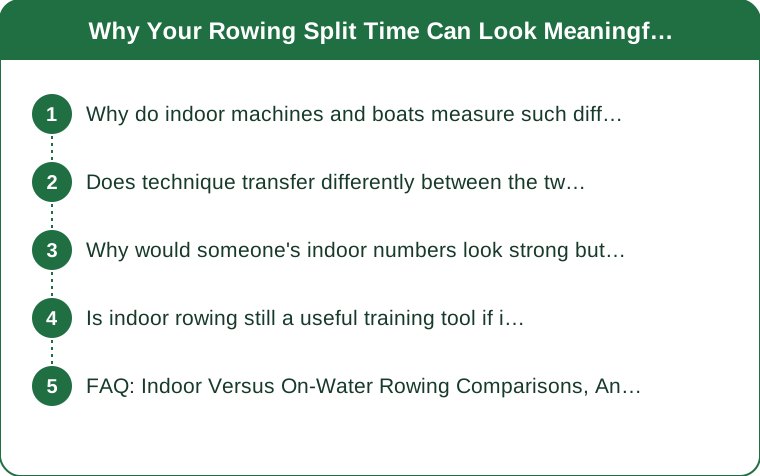
Why do indoor machines and boats measure such different things?
Indoor rowers calculate split time from measured power output against a fixed resistance mechanism, essentially isolating pure physical effort, while on-water speed is the result of that effort combined with boat design, water conditions, and, in a crew boat, synchronization with other rowers.
Does technique transfer differently between the two settings?
Yes — indoor machine technique optimizes for the specific resistance and flywheel mechanics of that equipment, which doesn’t always translate identically to the balance and blade-work demands of moving an actual boat through water.
Why would someone’s indoor numbers look strong but on-water performance feel disappointing by comparison?
Indoor rowing isolates raw power output from the additional skill demands of boat balance, blade timing, and reading water conditions, so strong indoor numbers reflect real fitness but don’t automatically predict on-water performance, which depends on additional skills as well.
Is indoor rowing still a useful training tool if it doesn’t directly predict on-water speed?
Yes — indoor rowing remains a valuable way to build the underlying power and conditioning that on-water performance depends on, even though it isn’t a direct stand-in for the full skill set that determines actual boat speed.
FAQ: Indoor Versus On-Water Rowing Comparisons, Answered
Is there a reliable conversion formula between indoor split times and boat speed?
No widely reliable, universal conversion exists, since too many boat- and condition-specific variables affect on-water speed beyond raw power output alone.
Should beginners focus more on indoor or on-water training first?
Many coaches recommend building base fitness and technique fundamentals indoors first, since it removes some variables and allows more controlled skill-building before adding boat-specific demands.
Does wind and water condition variability mean on-water splits are always less consistent than indoor ones?
Generally yes — indoor splits are more directly comparable session to session, since on-water splits are additionally influenced by conditions that change from one outing to the next.
TL;DR:
- Indoor split time measures power output against fixed resistance, isolating pure effort
- On-water speed adds boat design, water conditions, and crew coordination into the result
- Strong indoor numbers reflect real fitness but don’t automatically predict on-water performance
- Indoor rowing remains valuable training even though it isn’t a direct stand-in for on-water skill
Keep Reading
This article is for general informational and styling purposes only. Fit, sizing, and product availability may vary.