Why Your Rowing Splits Get Worse in the Second Half of Every Piece
Quick Answer: Second-half fade usually comes from a mechanical breakdown rather than a fitness limit. As fatigue accumulates, the drive sequence collapses from legs-back-arms toward a simultaneous heave, which shortens the effective stroke and drops power per stroke. You compensate with a higher stroke rate, which costs more energy and produces less boat speed, and the splits climb from there.
You go out at a pace that feels sustainable. Halfway through, the splits start drifting and you are pulling harder to hold the same number, and by the last quarter the number has left entirely. The frustrating part is that your legs do not feel like the limiting factor. That instinct is correct.

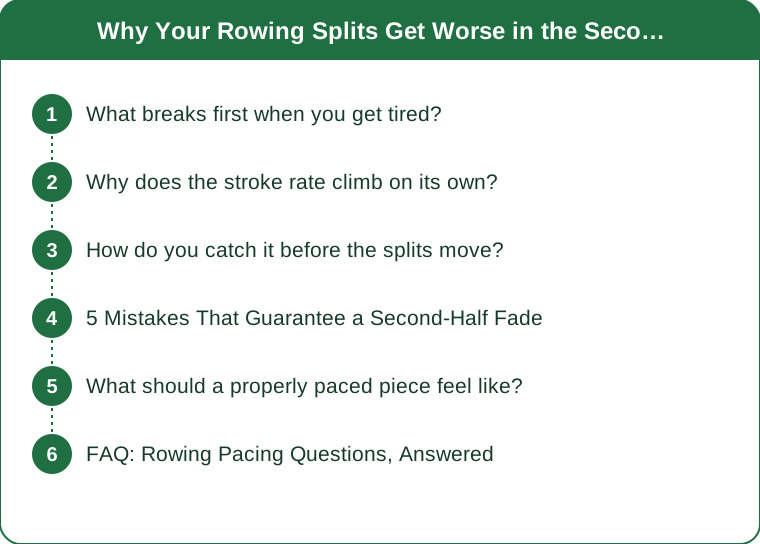
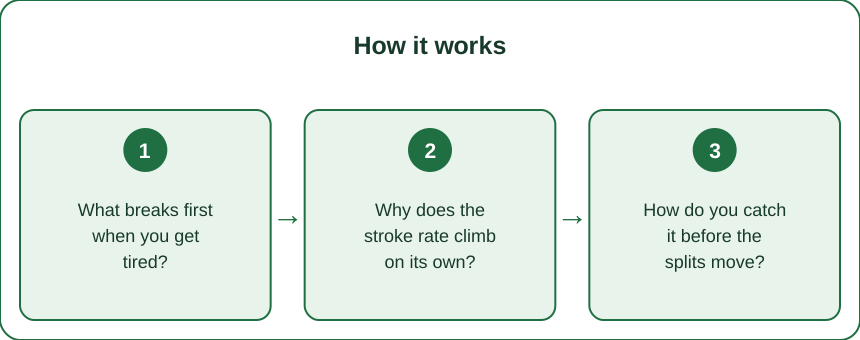
What breaks first when you get tired?
The sequence, and it goes in a predictable order.
A correct drive is legs, then back, then arms — three segments firing in order so each hands off to the next. Done properly, the largest muscles do the majority of the work and the arms only finish a stroke that is already moving.
Under fatigue, that order compresses. The back starts opening before the legs have finished driving, and the arms break early. The three segments start overlapping instead of sequencing, which sounds minor and is not — an overlapping drive is shorter and less powerful, because each segment is now working against a body position that is already moving away from it.
The measurable consequence is a shorter effective stroke. You are covering less distance per stroke while spending similar energy. On the monitor this shows up as splits drifting even though your effort has gone up.
The order of collapse is consistent enough to check yourself against: hands break early first, then the back opens early, then the legs stop finishing. If you can catch the first one, the other two usually do not happen.
Why does the stroke rate climb on its own?
Because a shorter stroke arrives at the finish sooner, and the recovery does not lengthen to compensate.
Stroke rate is not something you consciously raise when tired. It rises because each stroke is taking less time, and your recovery timing stays proportional. The result is more strokes per minute at less power each, which is a straightforwardly worse trade.
The correct ratio on the drive-to-recovery is roughly 1:2 — the recovery should take about twice as long as the drive. Under fatigue, most people drift toward 1:1.3 or so. The slide comes forward fast, the catch gets rushed, and you arrive at the catch with your body not yet set, which guarantees the next drive is also compromised.
This is the compounding loop that produces the fade: shorter stroke, higher rate, rushed recovery, worse catch, shorter stroke again. Each cycle is slightly worse than the last, which is why the second half degrades progressively rather than dropping to a new stable level.
The intervention point is the recovery, not the drive. Deliberately slowing the slide by a fraction of a second per stroke breaks the loop, and it is available to you at any point in the piece.
How do you catch it before the splits move?
Watch the stroke rate rather than the split, because the rate moves first.
Set your monitor so stroke rate is visible and pick a target — say 24 for a steady piece. When the rate drifts up by two while the split holds, the fade has already started; you are working harder to maintain the same number. That is your intervention moment, and it typically arrives one to three minutes before the split actually degrades.
The fix, in order:
- Slow the recovery. Not the drive. Count the slide deliberately for ten strokes. This alone often resets the rate
- Re-establish the leg finish. Consciously push the legs all the way down before the back opens. It feels slow and it is not
- Delay the arms. Hands stay straight until the handle passes your knees. If you can feel your arms starting the stroke, that is the earliest failure and the easiest one to correct
A useful drill outside of hard pieces: legs-only rowing for a minute, then legs-and-back, then full stroke. It re-teaches the sequence in a low-fatigue state so it is more robust when fatigue arrives.

5 Mistakes That Guarantee a Second-Half Fade
1. Going out on feel rather than a number. The first two minutes of any piece feel dramatically easier than the same pace at minute eight, because fatigue has not accumulated. Pace set on early feel is almost always too fast. Set the target split before you start and hold it even when it feels easy.
2. Chasing the split with the handle. When the number drifts, the instinct is to pull harder with the arms — the segment least capable of producing power. This accelerates the sequence collapse. Drive with the legs harder, or accept the number.
3. Raising the damper because it feels more productive. A higher damper is not a harder workout in a useful sense; it changes the drag factor, which changes the stroke’s character. A very high damper makes the sequence collapse arrive earlier, because each stroke costs more and technique degrades faster under load. Most people are better served in a moderate drag range.
4. Rushing the catch to make up time. Arriving at the catch early means arriving unset — shins not vertical, body not hinged, handle not settled. Every rushed catch produces a weak drive, so the time you save arrives back as a slower split.
5. Never doing anything longer than the race distance. If your entire training is 2k and shorter, the second half of a 2k is unfamiliar territory. Steady work at a lower rate for 20 to 40 minutes builds both the aerobic base and the technical durability that keeps the sequence intact when tired.
What should a properly paced piece feel like?
Slightly wrong at the start and slightly heroic at the end, which is the opposite of how most people run them.
For a 2k, a common approach is a controlled start, a settle into a sustainable split, and a build over the last 500. The middle section should feel boring — that is the sign that the pace is correct rather than optimistic. If the middle feels like a fight, the start was too fast.
For steady work, the target is a rate low enough that you can hold the sequence intact for the whole duration. A lower rate with a longer, fully-sequenced stroke builds more than a higher rate with a collapsing one, even if the average split is similar, because you are training the pattern you actually want under fatigue.
Signs your pacing was right:
- Your stroke rate at the end is within about two of where it started
- Your final 500 is your fastest, not your slowest
- You could have gone about ten seconds longer, not five minutes
Signs it was not:
- The rate climbed steadily throughout
- You stopped watching the split because it was demoralizing
- Your legs feel fine afterwards and your lower back and arms do not — that means the wrong muscles did the work
That last one is worth taking seriously. Persistent lower back discomfort after rowing is usually a sequencing issue rather than a strength issue, and it responds better to fixing the drive order than to more back work. This is general information, not medical advice — if back pain is sharp or persistent, get it looked at properly.
FAQ: Rowing Pacing Questions, Answered
Should I lower my target split so I stop fading?
Probably yes, at least temporarily. A piece completed at an even split at a slower pace trains the sequence you want and builds a real reference point. A piece that starts fast and dies teaches your body the collapsing pattern. Drop the target by two to four seconds, hold it evenly for a few sessions, and then push it back down.
Does a higher stroke rate ever help?
Yes, at the end of a race or in short high-rate intervals where the stroke is deliberately trained at that rate. What does not help is the rate rising on its own as a symptom of a shortening stroke. The distinction is whether you chose it.
Why do my splits look worse on a different machine?
Different machines and different drag factors produce different numbers for the same effort, and machine wear affects it too. Compare your splits to your own history on the same machine at the same drag factor, and treat cross-machine comparisons as approximate. Chasing another machine’s number is a good way to blow up a piece.
TL;DR:
- The fade is a sequence collapse — legs, back and arms start overlapping instead of firing in order
- A shorter stroke raises the rate on its own, which costs more and produces less
- Watch stroke rate rather than split; the rate moves one to three minutes before the number does
- Fix the recovery first, then the leg finish, then delay the arms
The second half does not get worse because you ran out of fitness. It gets worse because the stroke got shorter, and a stroke that stays long is available at any point in the piece if you slow the slide down and let the legs finish.
Keep Reading
This article is for general informational and styling purposes only. Fit, sizing, and product availability may vary.